Blog
The 2-message script to re-engage a student who's gone quiet
To re-engage a student who’s gone quiet, send two short, personal messages: a check-in timed to how long they’ve been away (7, 14 or 30 days), then one follow-up three to seven days later that offers a concrete way back, such as a specific class or a pause instead of cancelling. Then stop, log the outcome, and give the student 14 days to return before you decide whether it worked.
Why two messages, not five
One message is easy to miss in a busy week. A third or fourth starts to read like a collections notice. Two messages do two different jobs:
- Message 1 opens the door. It shows someone noticed, without asking for anything.
- Message 2 makes walking through it easy. It offers one specific next step and permission to say “not right now.”
After that you stop. Silence is an answer too, and respecting it keeps the relationship intact if they come back in three months.
Time it by how long they’ve been away
Start with one number per student:
Days away = today − date of the last class they actually attended.
Then compare it with their normal rhythm. A student who trains three times a week usually goes two or three days between classes, so seven days away is already more than twice their normal gap. A once-a-week student at seven days has simply missed one class. A practical rule: reach out when days away is at least 3 × their usual gap between classes, and never later than 14 days.
| Days away | Stage | Message 1 goal | Message 2 (if no reply) |
|---|---|---|---|
| 7–13 | Check in | Say you noticed; ask how they are | After 3–4 days: “you’re welcome back whenever; want a different time?” |
| 14–29 | Make returning easy | Offer a specific class and day | After 3–4 days: mention a pause instead of cancelling, plus an opt-out |
| 30+ | Ask, don’t assume | Ask what changed; listen | After 7 days: leave the next step with them |
New students (first 90 days): move one stage earlier. A member in their second month who has been away for 7 days gets the 14-day message, because early habits break faster and they have fewer friends on the mat pulling them back.
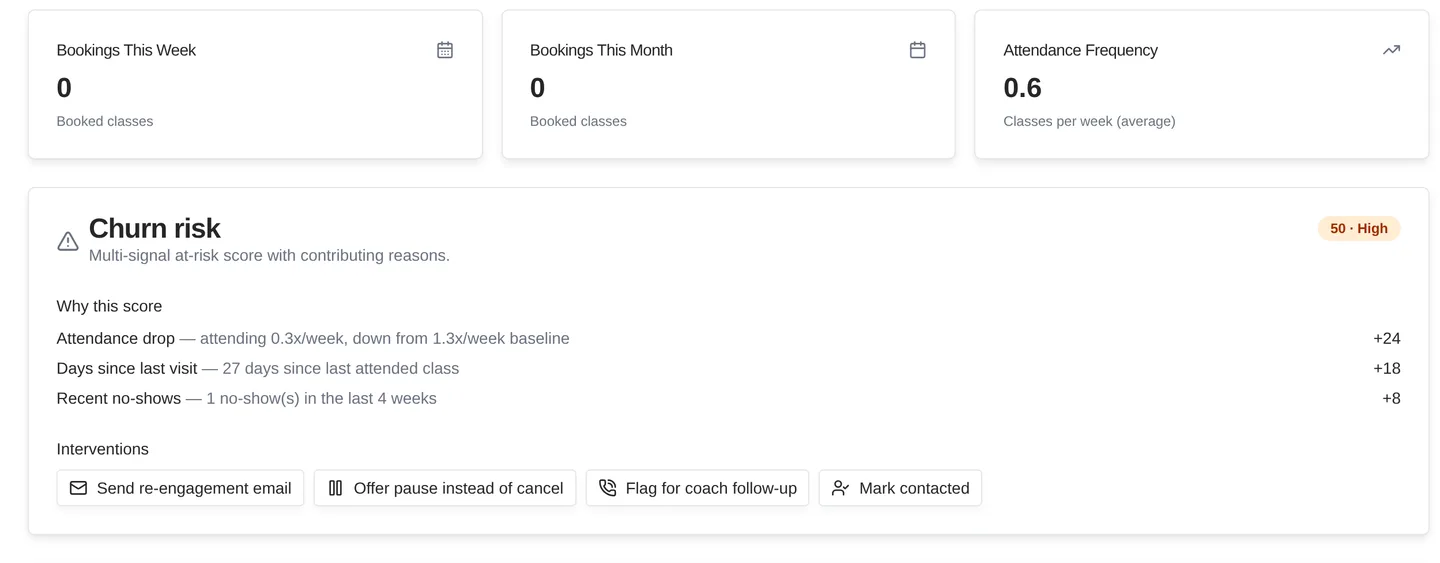
In GymClass, every flagged student’s profile shows the days since their last attended class next to the other risk reasons, so you can pick the stage without counting. See it live in the demo →
Message 1: the check-in
A good first message has five parts and fits in one phone screen (under 40 words on WhatsApp):
- their first name;
- one specific detail, like their usual class, their coach, or the time they train;
- one open question;
- a no-pressure line;
- a real person’s name, not “The Team.”
14-day example (WhatsApp):
Hi Laura, it’s been a couple of weeks since Tuesday night Gi and we’ve missed you on the mat. Everything okay? No pressure. If a different time works better now, tell me and I’ll help you find one. — Carlos
Send it during your normal contact hours, on the channel they already use with you. If they normally reply on WhatsApp, don’t switch to email for this.
Message 2: the easy way back
If there’s no reply, wait three to four days (seven at the 30-day stage) and send one follow-up. Offer exactly one concrete option, plus a polite way to opt out:
Hi Laura, one more note from me: I can save you a spot in Thursday’s 7 pm fundamentals if you’d like to ease back in. And if you need some time away, we can pause your membership instead of cancelling. If you’d rather not hear from us, just say so. — Carlos
Only offer a pause if your academy really allows one, and quote the actual rules. Don’t lead with a discount; it turns a personal check-in into a sales pitch and teaches students that disappearing earns a deal.
Then stop, log it and measure
Write one line per student: date, stage (7 / 14 / 30 / first 90 days), channel, reply, next step, and the date they came back, if they did. Count a student as returned if they attend a class within 14 days of message 1.
Win-back rate = students who returned within 14 days ÷ students you contacted.
Review it monthly by stage. If 4 of 10 students come back after a 14-day message but only 1 of 10 at 30 days, your outreach is starting too late. Move it earlier rather than writing a longer 30-day message.
What not to say
- Don’t guilt them (“the team misses you”, “you’re falling behind on your blue belt”).
- Don’t guess the reason, especially health, money or family.
- Don’t message on three channels at once after no reply.
- Don’t treat an attendance drop as proof they want to cancel. It’s a reason to ask, nothing more.
How GymClass does it
The manual version above works with a spreadsheet and a phone. GymClass handles the bookkeeping. Each at-risk student’s profile has a Churn risk card with a Why this score breakdown (days since last attended class, attendance drop, cadence change) and four interventions: Send re-engagement email, Offer pause instead of cancel, Flag for coach follow-up and Mark contacted.
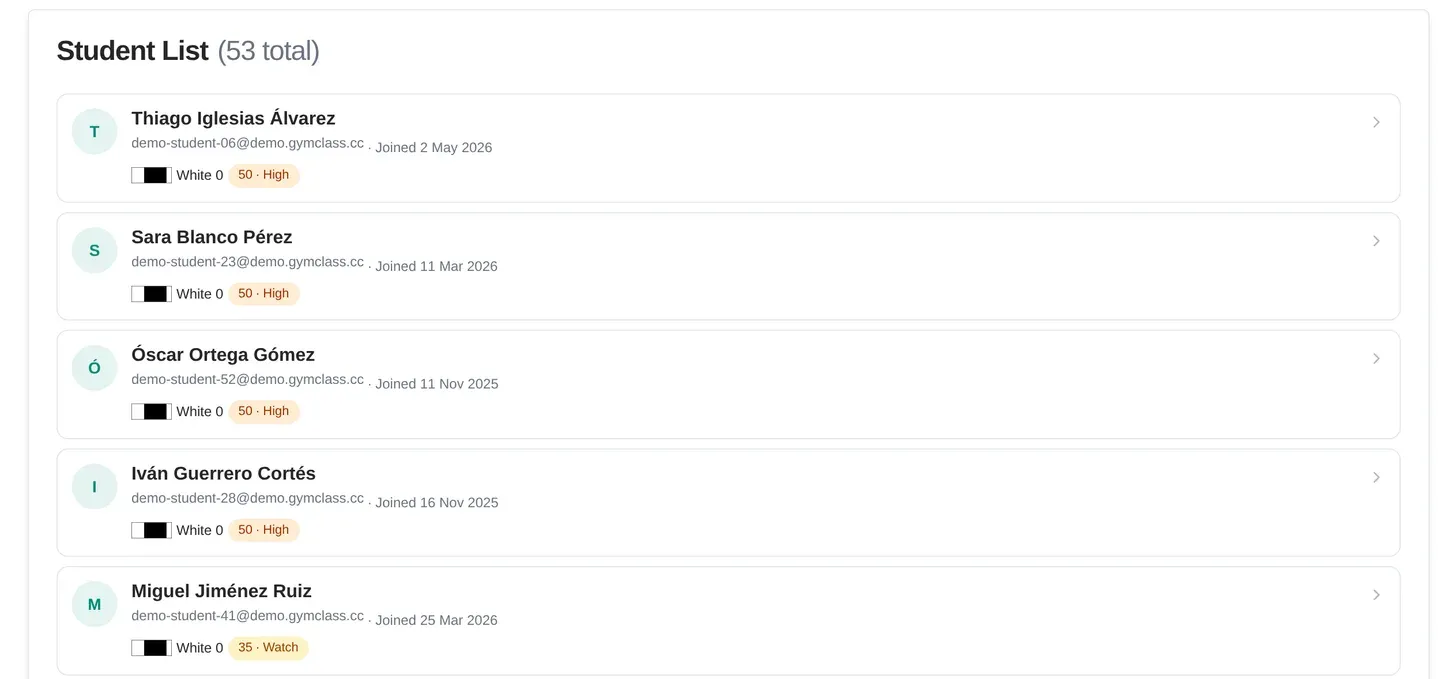
The re-engagement email is a “we miss you” draft generated from the student’s first name, days away, usual class and coach. You review and edit it before it sends, so it still sounds like you. Today that draft is written in Spanish, so English-speaking academies should rewrite it before sending. Every action lands in Intervention history and is marked Returned when the student attends a class within the academy’s return window (14 days by default), so the win-back rate above calculates itself. Use the profile’s Notes for what they told you on WhatsApp, so the next coach has context.
Get the full 7-, 14- and 30-day message pack, including first-90-days and pause wording, in the free Win-Back Scripts. To see the at-risk list and interventions on real-looking data, explore the GymClass demo academy.
Frequently asked questions
What should I text a student who stopped coming to class?
Send one short, personal check-in that names something specific, like their usual class or coach, asks one open question, and says there is no pressure. If they don't reply within three to seven days, send one follow-up with a concrete way back, then stop.
How long should I wait before contacting an absent student?
Start with a light check-in at about 7 days away, or sooner if they normally train three or more times a week. Use a 'make it easy to return' message at 14 days and an open 'what changed?' message at 30 days. Move new students in their first 90 days one stage earlier.
How many messages should I send before I stop?
Two. The first opens the door and the second makes walking through it easy. After that, log the outcome and leave the next step with the student; more messages tend to feel like pressure.