Blog
How to price BJJ memberships without guessing
To price a BJJ membership without guessing, start from your cost floor (monthly costs divided by paying members, adjusted for payment fees), compare it with the median unlimited price of academies near you, and build every other plan as a fixed ratio of that anchor price. A workable starting point: limited plans at 65–75% of unlimited, a premium plan at 115–125%, prepaid terms at 5–10% off, and family discounts of 10–15%, then check that your blended revenue per member stays above the floor.
The examples below use euros because they mirror the demo academy, but the formulas work in any currency.
Step 1: Find your cost floor
Your cost floor is the average amount each paying member must bring in for the academy to break even.
Cost floor = (fixed monthly costs ÷ paying members + variable cost per member) ÷ (1 − payment fee rate)
Fixed costs include rent, coach pay, your own salary, insurance, utilities, software, cleaning and equipment spread over its life (€3,000 of mats over 36 months is about €83 a month). Variable costs are the small things that grow with each member, such as supplies or a per-member software fee.
Worked example: €4,800 in fixed costs, 90 paying members, €3 of variable cost per member and 3% card fees.
(4,800 ÷ 90 + 3) ÷ 0.97 = (53.33 + 3) ÷ 0.97 = €58.07
Use the headcount you actually have, not the mat’s capacity. The floor moves fast when members leave: at 80 members the same academy needs (60 + 3) ÷ 0.97 = €64.95 per member. That is why pricing and keeping the students you already have are the same conversation.
Step 2: Anchor to your local market
List five to eight academies within a realistic commute for your students. For each one, write down the adult unlimited monthly price, any sign-up fee and the minimum contract. Use the median, not the average, so one premium gym doesn’t skew the picture.
Example: 65, 70, 75, 79, 85, 89, 120 → median €79.
Then compare it with your floor:
- Floor well below the median: price your unlimited plan at the median. Pricing lower leaves money on the table without adding much value for students.
- Floor close to or above the median: you have a cost or headcount problem, not a pricing problem. Charge above the market only if the difference is visible: more mat hours, a kids program, open mats, a credentialed head coach.
- Avoid being the cheapest gym in town. A student who joined to save €10 can leave to save €10.
In the example, a €58 floor and a €79 median make €79 unlimited your anchor.
Step 3: Build tiers as ratios of the anchor
Once the anchor is set, the other plans are ratios, not new guesses:
| Plan | Rule of thumb | Example (anchor €79) |
|---|---|---|
| Unlimited (anchor) | 100% | €79 / month |
| 2 classes per week | 65–75% of anchor | €55 (70%) |
| Competitor / all-in | 115–125% of anchor | €95 (120%) |
| Kids | Priced from its own class hours | €45 |
| Quarterly prepaid | 3 × anchor, 5–10% off | €213 (10% off) |
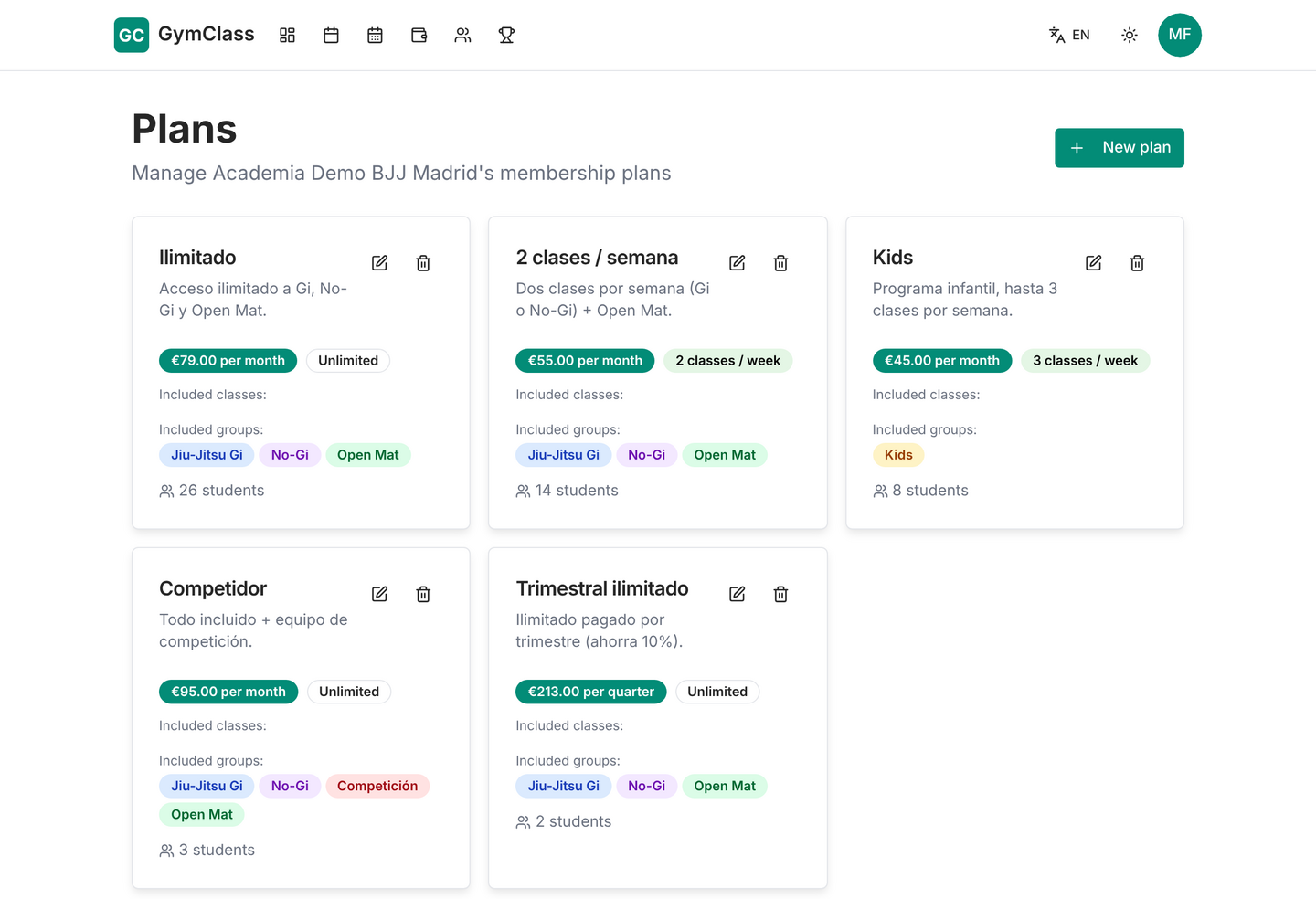
This is exactly the catalog the demo academy runs: see the membership plans live in the demo →.
Run one sanity check on the limited plan: price per class. Two classes a week is about 8.7 classes a month, so €55 ÷ 8.7 = €6.32 per class. A student training three times a week on unlimited gets about 13 classes, so €79 ÷ 13 = €6.08 per class. Once someone trains three times a week, unlimited is the better deal, which nudges your most committed students toward the anchor plan instead of punishing them for training more.
Keep the catalog small. Four or five plans are enough for most academies; every extra option is another price students compare and another rule your front desk has to explain.
Step 4: Add family plans without breaking the floor
Treat family pricing as a discount on the normal plan, not a separate flat family price: 10–15% off each additional family member, with the first member paying full price. It keeps one price list and makes the saving easy to explain.
Check each discounted price against the floor. At 15% off, unlimited becomes €79 × 0.85 = €67.15, still above €58. The 2-classes plan becomes €55 × 0.85 = €46.75, below the floor. That can be fine if few families use it, but you should know it before you print the flyer. Kids plans usually sit below the adult floor because kids classes are shorter and often share a coach; give them their own floor based on kids class hours.
Step 5: Check blended revenue before you publish
The last check is what your real member mix pays on average:
Blended revenue per member = Σ (share of members on a plan × monthly price)
With 40% on unlimited, 30% on 2 classes, 15% on kids, 10% on competitor and 5% on quarterly (€71 per month):
0.40 × 79 + 0.30 × 55 + 0.15 × 45 + 0.10 × 95 + 0.05 × 71 = €67.90
If 10% of members take the 15% family discount, that drops by about €1, to roughly €66.90. That is 15% above the €58.07 floor, or about (66.90 − 58.07) × 90 ≈ €795 a month of profit. Aim for blended revenue at least 15–20% above the floor so a few cancellations don’t put you underwater. If you fall short, move the mix toward the anchor plan before you raise every price.
When you change prices
Raise prices for new members first; that tests the new number without risking current students. For existing members, give at least 30 days’ notice and either keep their old price for three to six months or move them in a smaller step. Review the whole sheet once a year, or whenever your fixed costs change by more than about 10%.
How GymClass does it
In GymClass, the result of these five steps becomes your Plans catalog. Each plan has a price, a billing interval (monthly, quarterly, yearly or one-time), the classes or class groups it includes and an optional weekly or monthly booking limit, and each card shows how many students are on it.
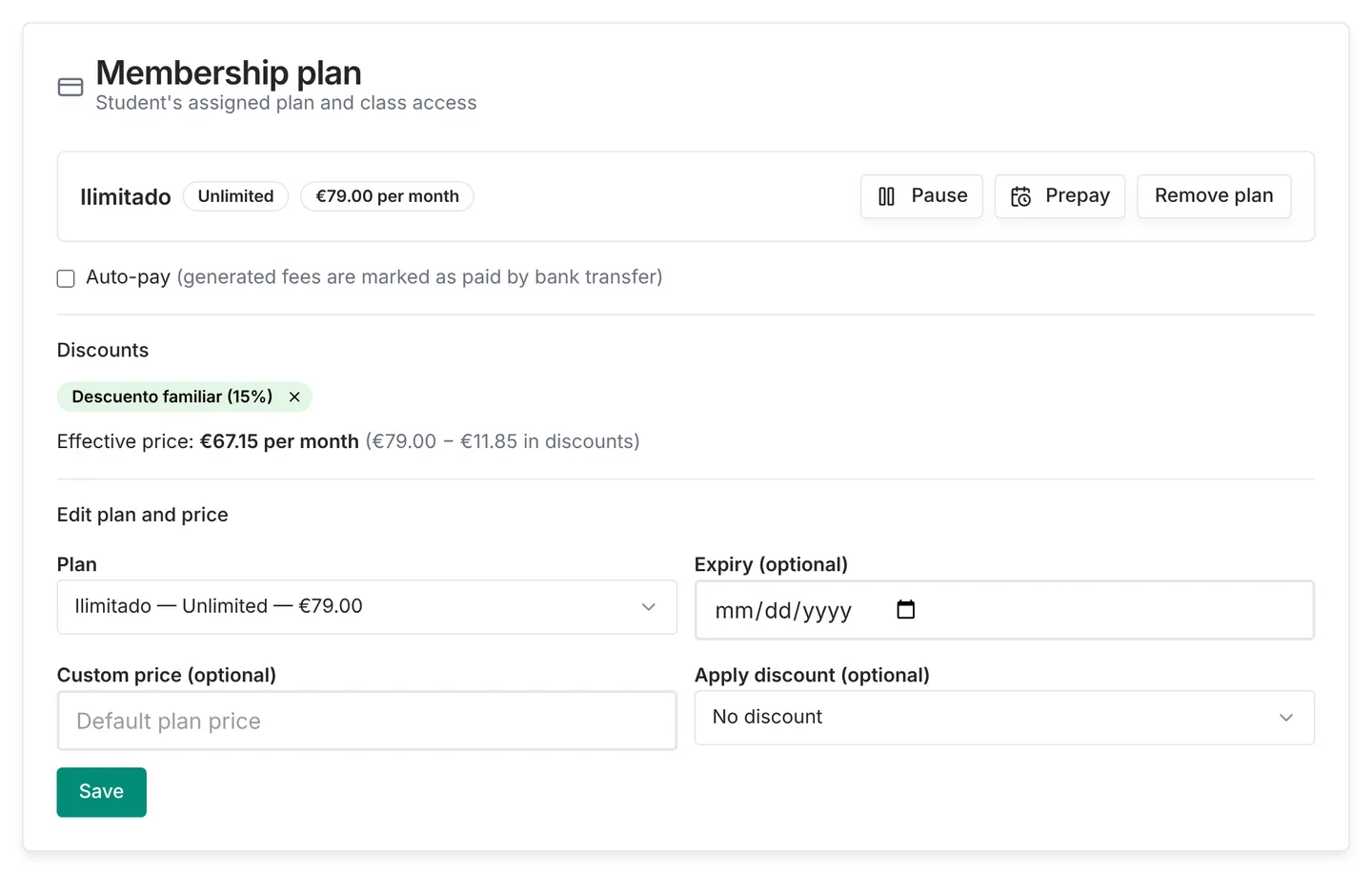
When you assign a plan from a student’s profile, you can set a custom price, apply a reusable discount such as a family discount and choose the first due date; billing then runs through Stripe. The booking limits from your tiers are enforced when students book.
Run the numbers with the free Membership Pricing Calculator, then see the plans and billing flow live in the demo academy.
Frequently asked questions
How much should I charge for a BJJ membership?
Work out your cost floor first: monthly costs divided by paying members, adjusted for payment fees. Then find the median unlimited price of academies near you. If your floor is below that median, price your unlimited plan at the median; if it is above, fix costs or headcount before charging more than the market.
Should my BJJ gym offer a family discount?
Yes, as long as every discounted price still clears your cost floor. Ten to fifteen percent off each additional family member is a reasonable starting point, applied as a discount on the normal plan rather than a separate flat family price.
How often should I raise membership prices?
Review prices once a year against your costs and the local market. Apply new prices to new members first and give current members at least 30 days' notice, or keep their old price for three to six months.